
Everygame’s Bitcoin withdrawal limit changes the exit calculation
The published cashier lists Bitcoin withdrawals from $100 to $2,500 per week for Bitcoin depositors. It permits one processed withdrawal per person within seven days. The listed operator charge is zero; the transfer description is “Instant after processing”.
That last qualifier matters. The same page places processing after a 48-hour/two-business-day pending stage, with processing Monday to Friday. Network delivery and the internal approval queue are separate stages. “Instant” does not describe the whole time between clicking Withdraw and receiving spendable funds.
A $10,000 eligible balance divided by the $2,500 ceiling requires at least four successful payments. The diagram is an illustration of that ceiling, not a forecast that Everygame will finish in four calendar weeks. Verification, eligibility, weekends and an account-specific restriction can extend the sequence.
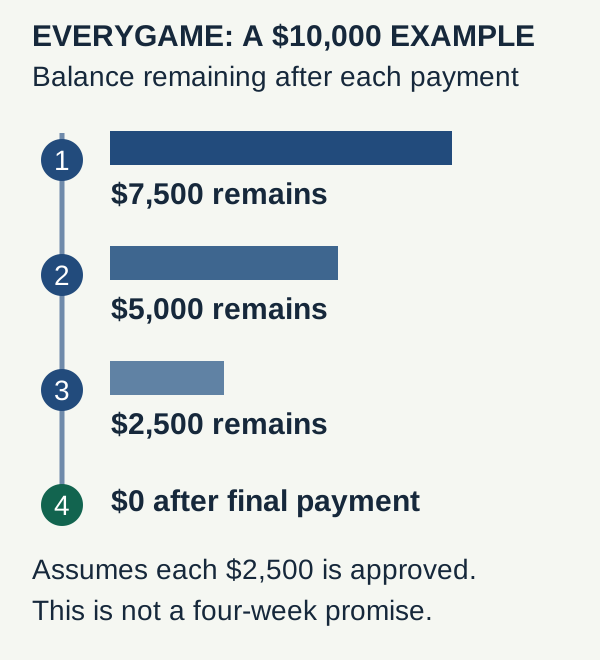
Why a successful small payment does not settle this issue
Receiving $100 demonstrates that one request completed. It does not test the experience of withdrawing $10,000, because the latter balance remains exposed to several later approval decisions. The concern is the amount left inside the account between payments, not whether Bitcoin itself is fast.
The cashier also lists a cheque route with a $150–$3,000 weekly range, a $60 fee and a 4–12-business-day delivery estimate. It is not automatically a cheaper or faster substitute, and eligibility differs. Confirm the available route in the account rather than combining the best headline from each method.
Red and Classic are not one bonus contract
Everygame has separate casino rulebooks. The Red terms are version 1.2, dated 12 March 2026; the reviewed Classic bonus terms are version 1.1, dated 19 September 2025. A review quoting one wagering multiplier for the whole brand loses a material distinction.
Casino Red
The standard deposit-bonus provision uses 30× deposit plus bonus. An illustrative $100 deposit and $100 bonus therefore produces $6,000 of required turnover under that rule.
The no-deposit subsection doubles the standard requirement; free-spin winnings have a separate 60× rule. These provisions should not be applied indiscriminately to the ordinary deposit-bonus example.
Casino Classic
The general rule distinguishes matches of 100% or less: 20× deposit plus bonus, from matches above 100%: 30×. For a qualifying $100 + $100 example at 20×, the arithmetic is $4,000.
Its contribution exclusions include blackjack, video poker, roulette and jackpot games; bonus play on roulette is prohibited. A game being available in the lobby does not mean it qualifies for the promotion.
These examples compare contract mechanics, not expected profit. Turnover is the cumulative value of wagers, not a fee paid once; losses can exhaust the balance before completion. The displayed bonus balance should not be treated as freely withdrawable cash.
The useful record is the accepted offer
For a disputed bonus, identify Red or Classic and the accepted offer before applying a rule from either contract. The product comparison above is the starting point.
The $83,816.72 dispute continued after it was marked resolved
The LCB support thread contains an April 2023 allegation that $83,816.72 was removed over bonus eligibility. On 11 April, the player reported restoration and requested a first $2,500 payment. The moderator marked the case resolved on 20 April after inactivity.
But the story continued. On 31 May, the player reported receiving three $2,500 instalments, then alleged a new $76,847 confiscation and closure. On 12 July, the moderator said the operator would not provide further evidence because of the matter’s sensitive nature, and closed the complaint.
The thread supports player-reported partial payments followed by a new unresolved dispute. The later $76,847 is separately reported, not calculated by subtracting the three instalments from $83,816.72. Private evidence needed to decide the fraud allegation was not available.
This is a historical example, not a measurement of Everygame’s current payout success rate. Its relevance to today’s review is the interaction between staged withdrawals and further account decisions while a substantial balance remains inside.
When an Everygame payout stalls, locate the stage
The Red contract allows identity, payment-ownership and source-of-funds checks. It also distinguishes cashout processing from delivery and warns that first requests or changed account details may need extra time. It does not let us calculate a maximum end-to-end verification period for a particular account.
The $2,500 weekly ceiling can explain a balance waiting for later instalments. It does not explain why an approved instalment has not been sent. The withdrawal-status guide separates the internal queue, verification, broadcast and receiving-wallet stages.
A recognisable brand does not complete the licence check
The reviewed documents sit on account.everygame.eu, casino.everygame.eu and classic.everygame.eu. Those linked product records establish a coherent branded service. They do not, on their own, supply a current regulator certificate explicitly covering the domain and the relevant contracting entity.
We have not independently established that current domain-specific licence in this inspection. This is an unresolved verification gap, not proof that the business has no licence anywhere. We therefore avoid converting brand longevity or an old licensing reference into present regulatory assurance.
For a formal dispute, the useful identifiers are the legal entity in the account agreement, the licensed jurisdiction and the complaint body with authority over that entity. A generic Everygame support signature does not replace those identifiers.
Exclusion can cover one product or all wagering
Everygame’s responsible-gaming page offers restrictions on individual products or all wagering. Its published process requires completing and returning a self-exclusion form, after which it says it will update the account and confirm by email. We did not test activation.
In this multi-product service, excluding Red alone differs from restricting all wagering. The confirmation needs the chosen scope and duration; the protection guide offers an independent request template.
Who should be cautious about Everygame?
The weekly ceiling leaves a large balance exposed to further account decisions while instalments are pending. The historical case illustrates that sequence, without measuring current payout success.
Red and Classic need to be identified before assessing an offer or dispute. Their separate contracts prevent a brand-wide bonus summary from resolving which conditions governed a particular balance.
Everygame remains at 45/100: documented cashier figures earn credit, while release restrictions, incomplete licence verification and the limits of redress constrain the assessment. No funded account, timed cashout or private-control test was performed.
Everygame: how the 45/100 assessment is built
Evidence grade C. Points retained after this editorial revision; explanations refreshed to match the evidence. These are editorial weights, not a measured payment probability. Scoring methodology.
- Operator identity4 / 15
Evidence behind this criterion
Branded product records are identifiable, but the current legal counterparty was not independently reconciled in this inspection. Supporting section
- Licence & scope3 / 15
Evidence behind this criterion
No current certificate explicitly covering the reviewed domain was independently established. This is a verification gap, not proof of absent licensing. Supporting section
- Withdrawals & KYC7 / 15
Evidence behind this criterion
The pending stage and weekly cadence are published; document review can add time that the transfer estimate does not cover. Supporting section
- Payments9 / 12
Evidence behind this criterion
The cashier provides useful method-level figures, with eligibility and processing qualifications that limit a fast-payment claim. Supporting section
- Complaints & redress4 / 10
Evidence behind this criterion
The complete historical thread shows a later dispute after reported instalments; full recovery is not established by its earlier resolved label. Supporting section
- Domain & security6 / 8
Evidence behind this criterion
Public account, Red and Classic documents sit on matching Everygame subdomains. Private account controls were not tested. Supporting section
- Game integrity5 / 8
Evidence behind this criterion
Product-specific game contribution rules are available, but no independent current software or RNG audit was performed. Supporting section
- Terms & enforcement1 / 7
Evidence behind this criterion
Different product rulebooks and qualification wording make the accepted promotion essential to evaluating eligibility. Supporting section
- Player protection3 / 5
Evidence behind this criterion
The operator describes product-specific and all-wagering exclusion through a returned form; implementation was not tested. Supporting section
- Support continuity3 / 5
Evidence behind this criterion
The cashier and exclusion pages provide support routes. The examined historical escalation did not establish final recovery. Supporting section
Total 45 / 100
Sources and verification limits
- Everygame — cashier payout schedulePrimary method limits, eligibility, pending period and processing wording.
- Casino Red — terms, version 1.2Dated 12 March 2026; bonus, verification and withdrawal provisions.
- Casino Classic — bonus terms, version 1.1Dated 19 September 2025; match tiers and game contributions.
- LCB — Everygame support threadHistorical player allegations and moderator updates; read through the later closure.
- Everygame — responsible gamingForm-based exclusion and product/all-wagering scope; not an activation test.
Public sources checked for this revision on 9 October 2026 except items explicitly marked historical or not reconfirmed. Source findings can change.
Review history and corrections
9 October 2026 — editorial consolidation
Light edit: replaced the generic four-stage withdrawal tutorial with the weekly-instalment distinction. Kept the full post-resolution case chronology and separately reported later balance, plus Red/Classic and exclusion-scope differences.
9 October 2026 — evidence-led revision
Separated Red and Classic rules, clarified processing versus transfer, and corrected the historical dispute summary to include its later instalments and renewed hold. Added an illustrative large-balance exit diagram.
Reader experiences with Everygame
Long-standing customers and newcomers may have different perspectives on Everygame. Share what worked for you, or describe an account decision you are still trying to understand.
No reader experiences have been published yet.